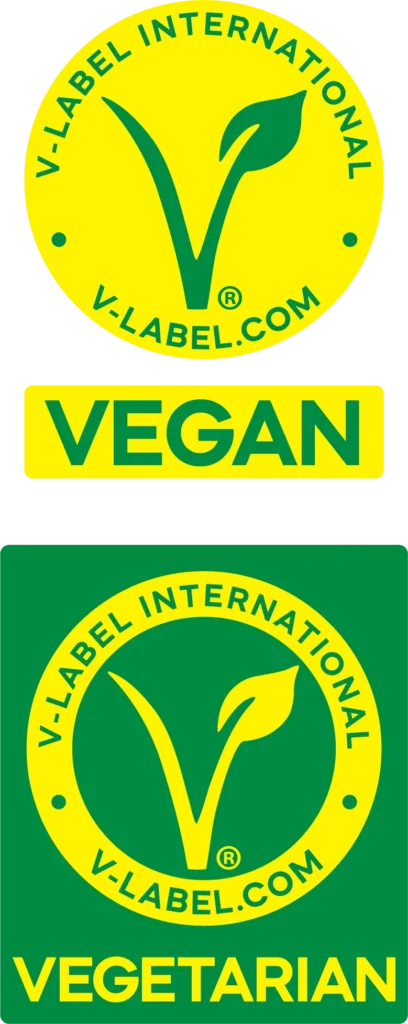
About the certification
V-Label is an internationally recognised and registered trademark for labelling vegan and vegetarian products and services. It was established in Switzerland in 1996 and is now one of the most widely used certifications of its kind. It enables consumers to identify more quickly products that meet the specified criteria for vegan or vegetarian labelling.
For products labelled as vegan, both the composition itself and the manufacturing and processing methods are inspected. No raw materials, additives, processing aids or other components of animal origin may be used. The criteria also cover, for example, gelatine, animal-derived colourants, beeswax, shellac and substances used to clarify food.
V-Label distinguishes between two basic categories: Vegan and Vegetarian. Under certain conditions, vegetarian products may use ingredients such as milk, eggs, honey, beeswax or lanolin, whereas the vegan category does not permit their use. Products bearing V-Label are also inspected according to uniform criteria, and each product is assessed individually.
The rules also include efforts to minimise the unintentional presence of animal-derived components during production. V-Label sets a guideline threshold of 0.1% for unintended traces and requires manufacturers to configure their processes to minimise the risk of contamination as far as possible. Products that must be labelled as containing GMOs under applicable regulations cannot obtain a V-Label licence.
The V-Label logo is therefore not merely a manufacturer's claim that its product is vegan or vegetarian. The label may be used only on products that have been assessed and approved by the relevant licensing body and hold valid certification.